
Two penetration testing quotes for the same application can differ by $15,000 or more. The lower quote is not always the better deal, and the higher quote is not always the better test. The difference usually comes down to how many days of manual testing you are paying for, who is doing the work, and what you receive at the end.
Ask every vendor the same 10 questions below. Put the answers side by side and the right choice becomes much easier to see.
Why Pen Test Quotes Vary So Much
Penetration testing is priced mostly on time. A quote reflects the number of testing days, the experience of the testers, and the amount of reporting and support included. Quotes look different when vendors make different assumptions about those three things.
Common reasons two quotes do not match:
- One vendor quoted five days of manual testing and the other quoted two quick days of lite testing
- One vendor is selling an automated vulnerability scan labeled as a penetration test
- One quote covers authenticated testing of several user roles and the other only covers the login page without authenticating
- One quote includes a retest and an attestation letter and the other charges extra for both
1. How Many Days of Testing Are Included?
This is the most important number in any quote. Ask for the number of testing days, separate from reporting and project management time.
If one vendor quotes five days and another quotes two days for the same application, they are not offering the same test. Divide the price by the testing days to compare quotes fairly.
2. Is This a Manual Penetration Test or an Automated Scan?
A vulnerability scan runs a tool and lists known issues. A penetration test uses a skilled person to find and exploit weaknesses, including access control and business logic flaws that scanners cannot detect.
Penetration tests cannot be automated. Avoid companies offering "automated" pen tests, which is often another name for a vulnerability scan. A scanner may attempt to "automatically exploit" a flaw to gather evidence that the vulnerability exists and is not a false positive. This does not make the scan a penetration test. Having someone review the scanner results does not make it a penetration test either.
PCI DSS is clear on this point. PCI DSS states that penetration tests are driven by manual efforts and must include more than reviewing and exploiting items from vulnerability scans. A penetration test may include vulnerability scanning, but it must also include separate manual testing that is not focused on the scan results.
Ask what percentage of the work is manual. Be cautious of any quote that is far below the others, promises results in a day, or cannot explain what the tester does beyond running tools. Many customers and auditors will reject a scan-only report.
At Central InfoSec: every penetration test is driven by manual testing performed by an experienced tester. Scanning tools may support some work but they never replace it.
3. Who Will Perform the Test?
A company should be able to tell you exactly who will perform your test at the time you receive the quote. "One of our testers" is not a good answer. You may end up with an unqualified tester. Some firms sell with senior staff and deliver with junior staff or subcontractors.
Ask for the following information about your tester:
- Name
- Length of time at the company
- Location
- Number of years of penetration testing experience
- List of penetration testing certifications
At Central InfoSec: you know who your tester is when you receive your quote.
- Central InfoSec testers are all based in the U.S.
- The lead tester on each penetration test has 10+ years of experience
- Your lead tester holds 20+ certifications: CRTO, OSCP, OSWP, GPEN, GWAPT, GCPN, GMOB, PNPT, PJPT, PORP, PWPP, PWPA, PMPA, PIPA, PAPA, MCRTA, CRTA, C3SA, BTF, CEH, PenTest+, Security+, and A+
4. What Exactly Is in Scope?
A quote should state what will be tested in plain terms. Vague scope is the most common cause of surprise costs and missed coverage.
For a web application penetration test, the scope should list:
- The URLs and environments to be tested (production or staging)
- Whether testing is unauthenticated, authenticated, or both
- The number of user roles to be tested (for example user and admin)
- Whether the API is included
- Anything that is explicitly out of scope
5. What Methodology Do You Follow?
A professional firm can describe how it tests. For web applications, look for alignment with the OWASP Web Security Testing Guide and coverage of the OWASP Top 10. For networks, look for a recognized framework such as PTES.
You do not need to be an expert to judge the answer. A clear, specific explanation is a good sign. A short list of tool names is not a methodology.
6. Can We See a Sample Report?
The report is what you are buying. Ask for a sample before you sign.
A good report includes:
- An executive summary that a non-technical reader can understand
- Each finding with a severity rating and the business impact
- Evidence and steps to reproduce the issue
- Specific remediation guidance for your developers
If the sample looks like raw scanner output, the final report will too.
At Central InfoSec: every quote comes with a detailed breakdown of the proposed testing options, sample reports, example finding writeups, your assigned tester's qualifications and certifications, the tools to be used, and an overview of our testing methodology.
7. What Deliverables Are Included in the Price?
Ask for the number of deliverables and a list of everything you will receive. One or two PDF reports are not enough. Items that are often left out of lower quotes include:
- An attestation letter you can share with customers and auditors
- A debrief call to walk your team through the findings, if needed
- Immediate notification of critical vulnerabilities during testing
- After-business-hours support
- Testing after-business-hours, if preferred
- Support for questions from your developers after the report is delivered
If a customer or auditor asked you for proof of a penetration test, the attestation letter is often the document they want. Confirm that it is included.
At Central InfoSec: every penetration test comes with at least four deliverables.
- Executive Summary Report for senior management and executive leadership
- Technical Details Report for the teams who will fix the findings
- Spreadsheet of Findings so you can assign, track, and remediate findings without painfully copying them out of a PDF
- Letter of Attestation to share with customers who need proof that testing was performed
8. Is Retesting Included?
After you fix the findings, a retest confirms the fixes worked and gives you an updated report showing the issues as resolved. Customers and auditors often ask whether findings were remediated.
Ask whether a retest is included, what it costs if it is not, and how long you have to request it. A quote without a retest can look cheaper until you need one.
9. When Can You Start and When Will We Have the Report?
If you have a deadline for an audit or a customer contract, timing matters as much as price. Ask each vendor for three dates:
- The earliest testing start date
- The date testing will finish
- The date the final report will be delivered
Get the dates in writing. A low price is not helpful if the report arrives after your deadline.
Be aware of response times before you sign, too. It usually should not take weeks to get a quote. A company that is slow to send a quote is often slow to schedule, test, and report.
10. Is the Price Fixed and What Could Change It?
Ask whether the quote is a fixed price or an estimate. Then ask what would cause the price to change.
Clarify these points before you sign:
- Is the price fixed for the scope described?
- What happens if the application is larger than expected?
- Are there separate fees for the report, the debrief, the letter, or the retest?
- Are there lower cost options, such as a time-boxed test, and what do they leave out?
Pen Test Quote Comparison Checklist
Use this checklist to compare each quote you receive:
- Number of manual testing days
- Price per testing day
- Manual penetration test, not an "automated" pen test or vulnerability scan
- Tester name, length of time at the company, and location
- Tester years of penetration testing experience
- Tester penetration testing certifications
- Scope, including authenticated testing, user roles, and API
- Methodology
- Sample report quality
- Number of deliverables, including attestation letter and debrief call
- How quickly the company responded with a quote
- Retest terms and cost
- Start date and report delivery date
- Fixed price and exclusions
Red Flags in a Pen Test Quote
Be careful if a vendor:
- Will not tell you how many days of testing are included
- Answers "one of our testers" when you ask who will perform the test
- Offers an "automated" pen test
- Takes days or weeks to send a quote
- Will not share a sample report
- Will not share their testing methodology
- Quotes a price without researching or asking about your application, user roles, or goals
- Guarantees that no vulnerabilities will be found, or that you will pass an audit
Get a Pen Test Quote That Answers All 10 Questions
A Central InfoSec quote is built to be compared. Every quote we send includes the details that this article tells you to ask for, so you do not have to chase them.
- Testing options: a standard assessment and lower cost time-boxed options, with the testing time for each stated clearly
- Meet your tester: understand who will be performing your test, where they are located (US-based), what their background is, number of years of penetration testing experience, qualifications, and professional certifications.
- Example reporting output: see what your report will look like before you sign
- Example findings: see the level of detail, evidence, and remediation guidance you will receive
- Our methodology: how we test, written in plain language
Here is how Central InfoSec answers the questions that matter most:
- Who performs the test: a named, U.S.-based lead tester with 10+ years of penetration testing experience and 20+ certifications, including CRTO, OSCP, OSWP, GPEN, GWAPT, GCPN, GMOB, PNPT, and more.
- Manual or automated: manual testing on every engagement, never a vulnerability scan sold as a pen test
- Deliverables: four deliverables, including a Spreadsheet of Findings and a Letter of Attestation, not just one or two PDF reports
- Critical findings: reported right away with ad-hoc reporting and a debrief if needed
Our team builds its own tools, including Burp Suite extensions, and relies on manual analysis to find the vulnerabilities that automated scanners miss.
Comparing Pen Test Quotes
Already have a quote from another vendor? Send us the same scope and compare the two side by side using the 10 questions above.
Tell us about your application and we will send you a free customized quote: Get a Free Pen Test Quote
Recent Pen Test Awards

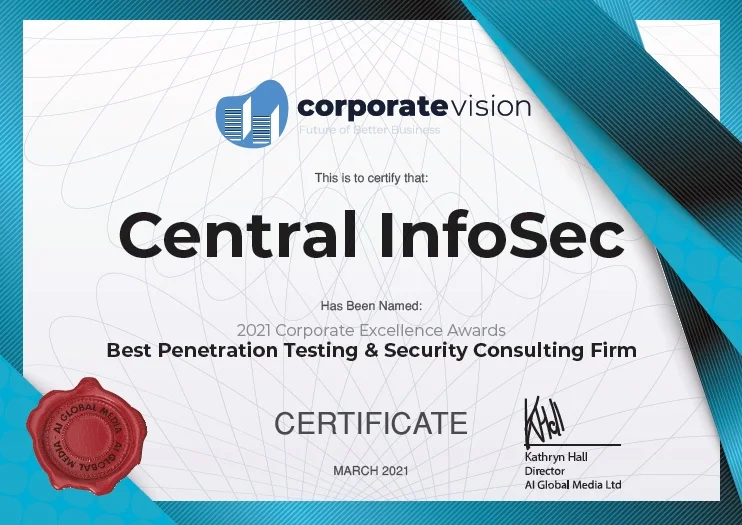
Central InfoSec named Best Boutique Penetration Testing Company by the Global 100 Awards.

Central InfoSec named Best Pen Test Company of the Year and Top 10 Penetration Testing Services Providers by The Cyber Security Review.